Venice– 08-13 January 2026
From 8 to 13 January 2026, IUAV University of Venice hosted MSP TALKS – Towards maritime sustainability in the Mediterranean Sea and beyond, a three-day series of lectures and discussions bringing together scholars, practitioners and policy actors at the forefront of Maritime Spatial Planning (MSP).
Organised within the course An Introduction to Maritime Spatial Planning, and supported by EU-funded research projects MEDIGREEN and INCORE-MED, the initiative created a shared space for critical reflection on how MSP can respond to contemporary challenges: nature conservation, land–sea interactions, sectoral transitions and evidence-based policy development.
Across the three days, MSP TALKS fostered an open dialogue between theory and practice, highlighting the evolving role of MSP as a strategic tool for sustainable maritime governance.
Day 1 – Understanding land–sea interactions as planning hotspots
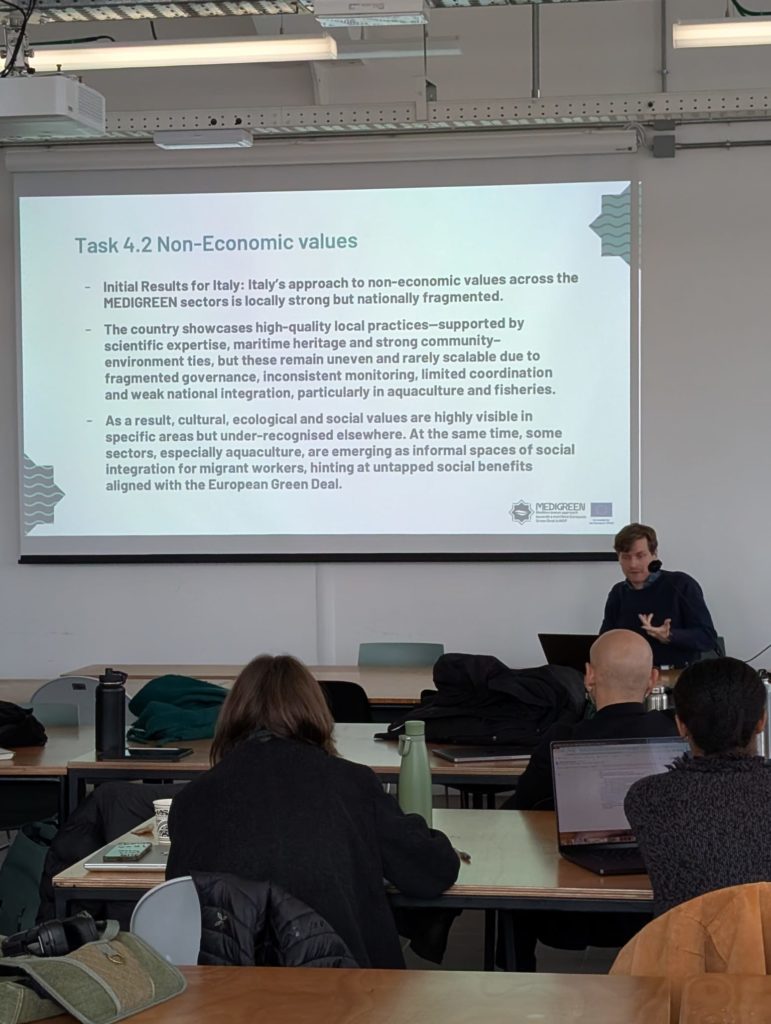
The opening lecture, held on Thursday 8 January, was delivered by Alberto Innocenti (University of Southern Denmark).
Focusing on the land–sea continuum as a hotspot of interactions, the presentation explored how coastal zones concentrate environmental pressures, socio-economic dynamics and governance complexity. Through international examples, the talk highlighted the need for MSP and ICZM to work in closer synergy, particularly in addressing cumulative impacts, spatial conflicts and climate-related risks.
The discussion that followed underlined the importance of spatial data, planning scales and cross-sectoral coordination in navigating these transitional zones.
Day 2 – MSPglobal and the international dimension of planning
On Monday 12 January, Niccolò Bassan (UNESCO-IOC) offered a global perspective on MSP through the lens of MSPglobal.
The lecture examined how international cooperation, capacity-building and shared methodological frameworks are shaping MSP implementation worldwide. Particular attention was given to the role of science-policy interfaces and to the transferability of planning approaches across diverse geopolitical and environmental contexts.
The dialogue highlighted how global initiatives can support national and regional MSP processes, strengthening coherence between policy ambitions and operational tools.
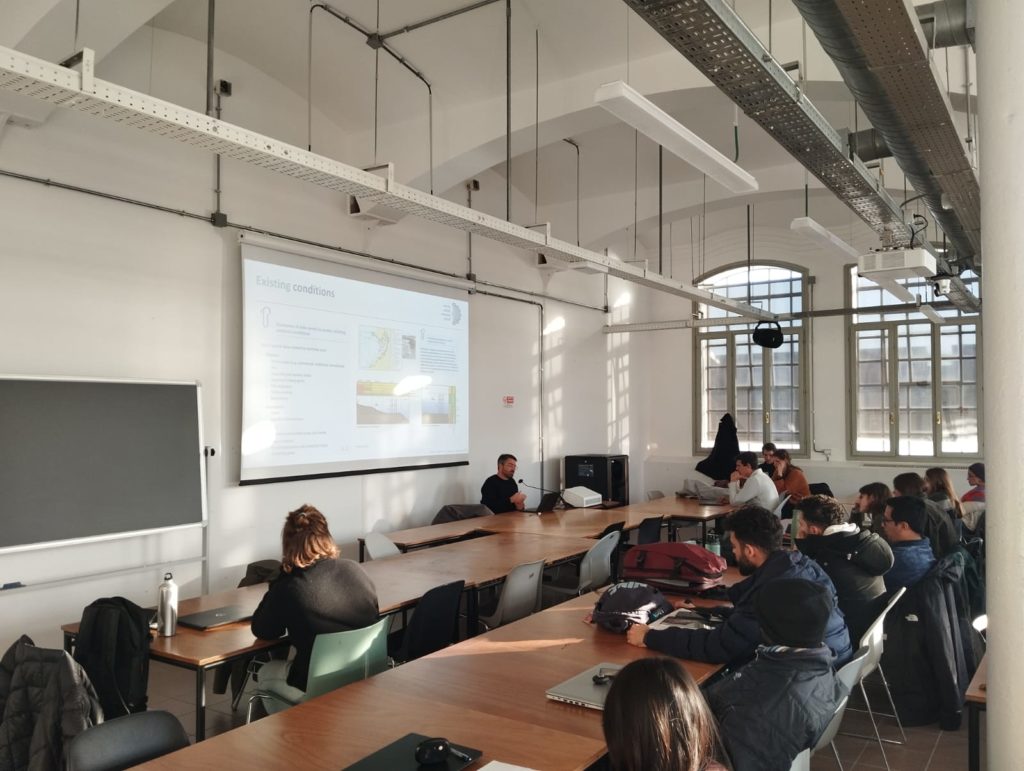
Day 3 – Integrating conservation and restoration into MSP
The final session, held on Tuesday 13 January, featured Elisabetta Manea (LECOB, CNRS–Sorbonne Université).
Her presentation addressed the integration of marine conservation and restoration objectives within MSP, emphasising biodiversity protection, ecosystem-based management and the use of scientific evidence in planning decisions.
By bridging ecological research and spatial planning practice, the lecture stimulated a rich discussion on how MSP can move beyond conflict mitigation to actively support nature-positive futures.
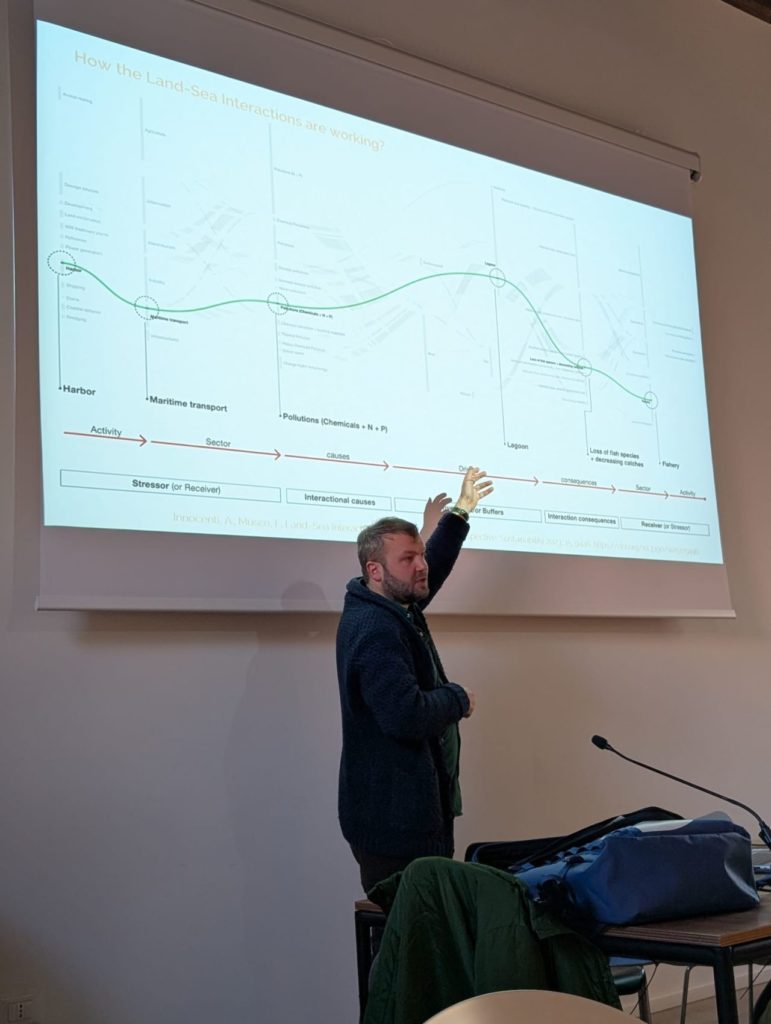
Folco Soffietti (University Iuav of Venice) complemented the intervention by offering insights into initial results of projects INCORE-MED, MEDIGREEN and Poseidone. Explaining the efforts of the University in contributing to the evolution of maritime planning by researching participatory approaches to tackle Climate Change and socio-cultural values of maritime uses for improved social and ecological sustainability.
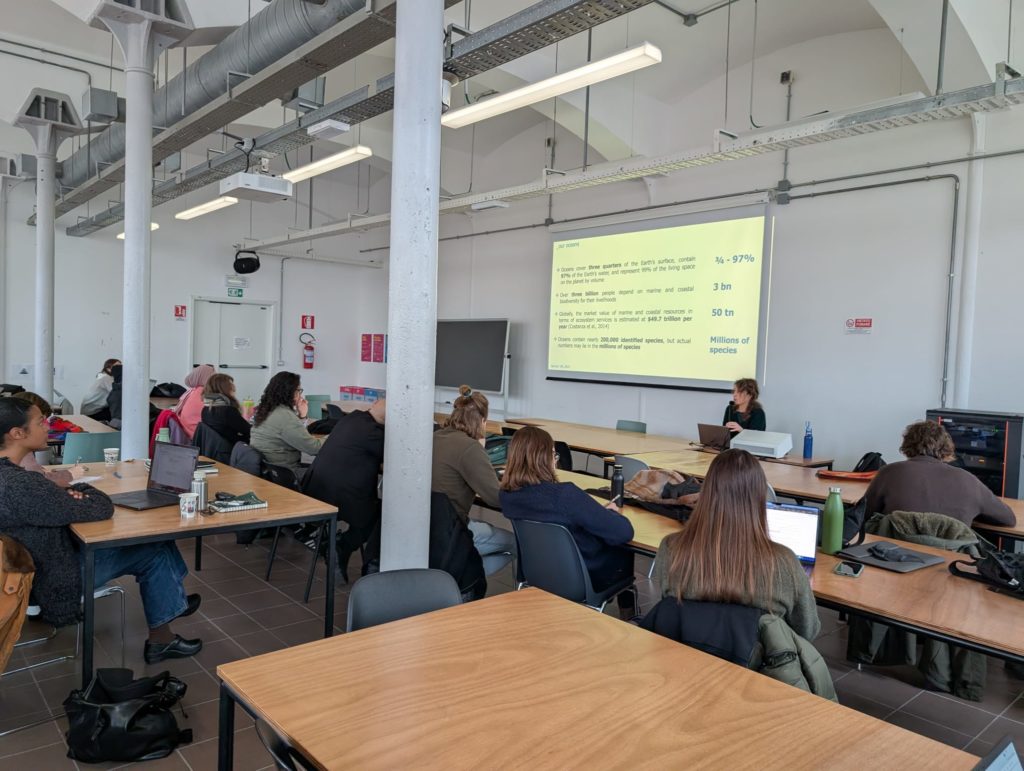
A shared space for learning and exchange
Beyond individual lectures, MSP TALKS functioned as a collective learning experience, encouraging students and researchers to engage critically with contemporary MSP debates. The series confirmed the value of academic spaces where research, policy and design perspectives intersect, reinforcing MSP’s role as a key instrument for sustainable maritime transitions in the Mediterranean and beyond.
Organisers: Vittore Negretto, Davide Longato, Fabio Carella
Discussants: Giulia Lucertini, Daniele Brigolini, Paolo De Martino, Folco Soffietti, Francesco Musco